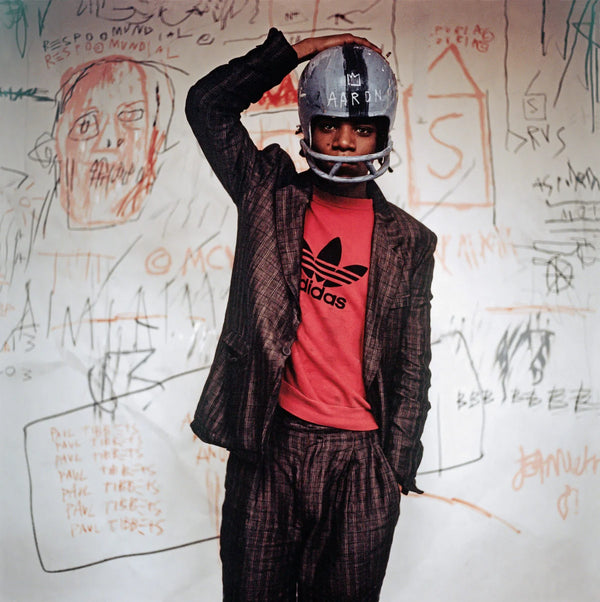



Ironie d'un policier noir, 1981
Avant que Jean-Michel Basquiat ne devienne l'un des artistes les plus célèbres du XXe siècle, son œuvre était déjà légendaire dans les rues du centre de New York. Sous le pseudonyme de SAMO, ses symboles poétiques et poignants ont établi un langage visuel qui continue d'inspirer de nouvelles générations de graffeurs. Nous sommes très fiers de présenter cette édition de « Ironie d'un policier noir » sur planches de skate, dans le cadre de notre collaboration avec la Succession de Jean-Michel Basquiat.
© Succession de Jean-Michel Basquiat. Licence accordée par Artestar, New York.
About the Artist

Jean-Michel Basquiat (1960–1988) was a groundbreaking American artist who rose from the streets of New York to global acclaim in the early 1980s. Beginning as a graffiti artist under the name SAMO, Basquiat brought a raw, powerful visual language to the art world — combining text, symbols, skulls, crowns, and cultural references in a frenetic, expressive style.
His work challenges racial injustice, class power, and the commodification of Black culture, often blending elements of jazz, African heritage, and anatomical imagery. Though his career was brief, Basquiat’s influence on contemporary art, fashion, and culture remains profound.
Today, his work is exhibited in the most prestigious institutions, and his legacy continues to inspire new generations of artists and cultural disruptors.
Jean-Michel Basquiat (1960–1988) was a groundbreaking American artist who rose from the streets of New York to global acclaim in the early 1980s. Beginning as a graffiti artist under the name SAMO, Basquiat brought a raw, powerful visual language to the art world — combining text, symbols, skulls, crowns, and cultural references in a frenetic, expressive style.
His work challenges racial injustice, class power, and the commodification of Black culture, often blending elements of jazz, African heritage, and anatomical imagery. Though his career was brief, Basquiat’s influence on contemporary art, fashion, and culture remains profound.
Today, his work is exhibited in the most prestigious institutions, and his legacy continues to inspire new generations of artists and cultural disruptors.